
Apush calculator
You want to know exactly how ready you are for the AP® U.S. History (APUSH) exam, right? That’s where the APUSH Score Calculator comes in, a simple, smart tool that predicts your AP® U.S. History score before test day.
It helps you find weak spots, plan smarter, and focus only on what matters.
So instead of guessing, you’ll prepare with precision, confidence, and a clear path to a 3, 4, or 5 on AP® U.S. History.
What Is the APUSH Score Calculator?
The APUSH Calculator (also called the AP® U.S. History Score Calculator) is an online tool that estimates your exam score based on your raw results in each section.
It mirrors the College Board scoring model, converting your multiple-choice, SAQ, DBQ, and LEQ results into a predicted AP® score (1–5).
Think of it like a performance mirror. You enter your practice test results, and it instantly shows how close you are to your goal score.
In short:
- Simulates official AP® scoring by the College Board
- Shows how each section impacts your final score
- Helps you understand your strengths and weaknesses
- Guides your study and time management strategy.
If you’re also tracking your academic grades beyond AP exams, try using our GPA Calculator to stay consistent across subjects.
APUSH Exam Structure: What You’re Up Against
The AP® U.S. History Exam tests your understanding of major themes, concepts, and historical thinking skills such as Comparison, Causation, and Continuity and Change, from the colonial period to modern America.
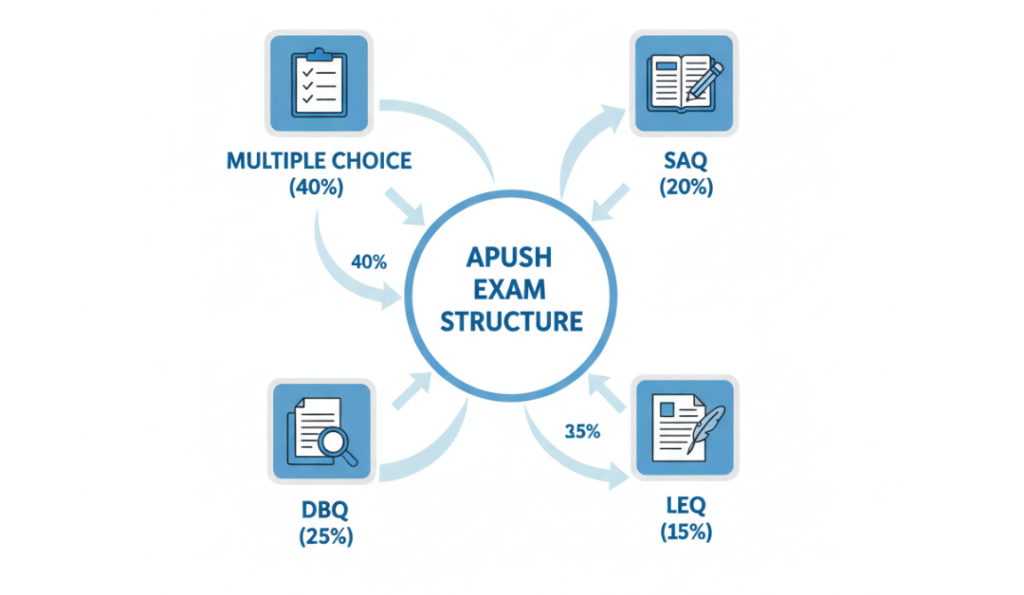
It’s divided into four main components, each with its own weight in your final AP® score.
1. Multiple-Choice Questions (MCQ) 40% Weight
You’ll face 55 questions in 55 minutes, testing your ability to analyze sources, charts, and maps.
Each set includes 3–4 questions tied to a single document or image.
The APUSH Score Calculator shows how many correct MCQs you need to reach a 3, 4, or 5.
2. Short-Answer Questions (SAQ) 20% Weight
Three questions worth 9 total points, 40 minutes total.
Questions 1 and 2 are required; 3 or 4 is your choice.
A–C–E Method:
A: Answer directly.
C: Cite evidence.
E: Explain reasoning clearly.
A strong SAQ section can move your predicted result from a 3 to a 4 in the APUSH Calculator.
3. Document-Based Question (DBQ) 25% Weight
The DBQ is the centerpiece of the APUSH Exam. It measures your ability to analyze historical documents and craft a clear argument.
Time: 15 minutes reading + 45 minutes writing (60 minutes total)
Rubric: 7 points total (thesis, evidence, analysis, sourcing, and context)
To earn full points:
- Use at least six of the seven documents
- Add outside historical evidence
- Maintain a clear, defensible thesis
According to the APUSH Exam Score Calculator, improving your DBQ score can boost your total AP® score significantly, sometimes by a full point.
4. Long Essay Question (LEQ) 15% Weight
You’ll write one essay in 40 minutes, choosing one of three prompts.
It’s graded on a 6-point rubric, testing one of the three key skills, Comparison, Causation, or Continuity and Change.
Even though it’s the smallest section, your LEQ can still make a difference.
According to many APUSH test calculators, a strong LEQ performance can push you from a 4 to a solid 5.
To keep your academic performance balanced, you can also check your semester averages using the CGPA Calculator.
How the APUSH Calculator Works
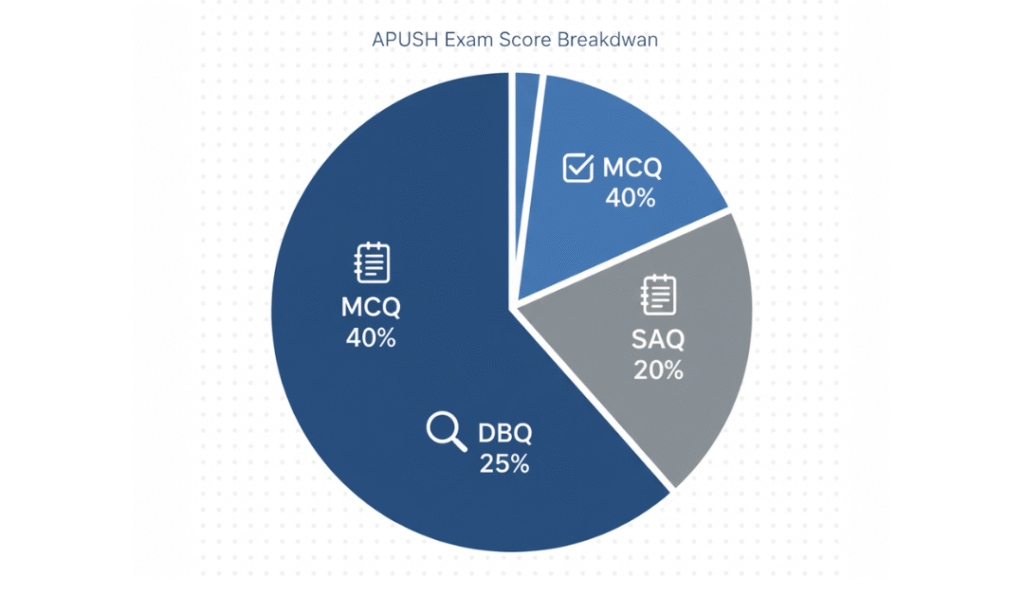
The score calculator combines your MCQ, SAQ, DBQ, and LEQ results to form a composite score (out of ~130).
It then converts that composite using College Board weightings:
| Section | Weight | Example Raw Score |
|---|---|---|
| MCQ | 40% | 38 / 55 |
| SAQ | 20% | 7 / 9 |
| DBQ | 25% | 5 / 7 |
| LEQ | 15% | 4 / 6 |
➡️ Predicted composite: ~90 / 130
➡️ Estimated AP® Score: 4 (Well Qualified)
The APUSH Exam Score Calculator helps you visualize how small improvements can raise your total. For example, answering just 3–4 more MCQs correctly can mean a higher final score.

Expert Strategies to Boost Your AP® U.S. History Score
1. Master Multiple-Choice Strategy
Use process of elimination to remove incorrect or extreme options.
Each extra correct answer shifts your predicted score upward in the calculator.
2. Analyze Sources First
Identify the author, date, and purpose before reading fully.
This speeds up comprehension and improves accuracy.
3. Build Essay Power (DBQ + LEQ)
- Start with a strong thesis
- Use specific historical evidence
- Connect each fact to your main argument
Your DBQ and LEQ combined form nearly 40% of your total AP® score, so consistency here is key.
Time Management Breakdown
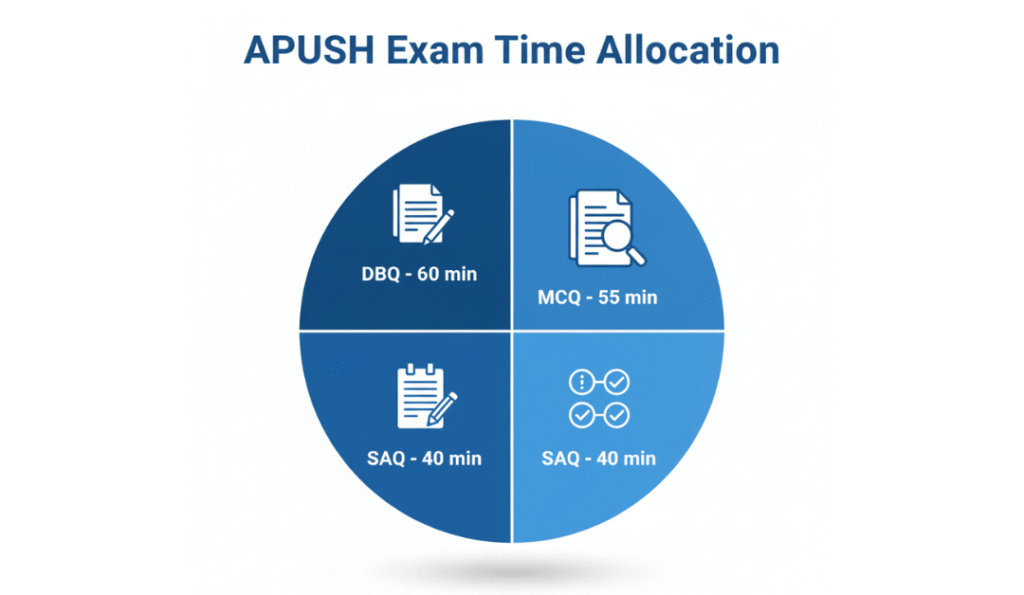
| Section | Time | Focus |
|---|---|---|
| MCQ | 55 min | 1 min per question |
| SAQ | 40 min | 13 min per question |
| DBQ | 60 min | Read + Write |
| LEQ | 40 min | Plan + Write |
Use the APUSH Exam Calculator after every timed practice to track progress and improvement week by week.
Key Facts About the APUSH Exam
- Roughly 12–13% of students earn a 5 each year.
- The average AP® U.S. History score is between 2.7 and 3.2.
- The DBQ section alone can shift your total by 25%.
- There’s no negative marking, so guessing always helps.
- The College Board occasionally updates its score distributions, so check the latest data before testing.

Conclusion
If you’re aiming for excellence on the AP® U.S. History Exam, don’t rely on guesswork.
Use the APUSH Score Calculator as your personal progress and performance tracker.
It demonstrates how your effort translates into real progress, section by section.
Every time you finish a practice test, plug in your scores to see how your performance changes and how close you are to earning a 5 on AP® U.S. History.